

The Dark Dreamscape of Dance Theatre in ‘Naraku’
- Elspeth Chan

- Sep 30, 2025
- 3 min read
Presented with support from the Japan Foundation, Naraku by Yoshimitsu Kushida and Dance Company Lasta plunges audiences into a visceral psychodrama where desire, ego, and obsession collide. First seen in Yokohama in 2020, later adapted into an award-winning film, the piece arrives onstage as a relentless exploration of the unconscious — an abyss where fantasy blurs with reality.
On the stage is a carpet, two wooden chairs, a bookcase with scattered books, and Kushida himself sitting motionless behind a table. His stillness hovers between meditation and detachment, while what seems to be his dream plays out before the audience. Books, handled exclusively by Aoi Okamoto, symbolize fictional realms that mirror reality. It is only through her repeated interactions with books that the audience recognizes the reflections on the psyche’s instability and one’s destiny.
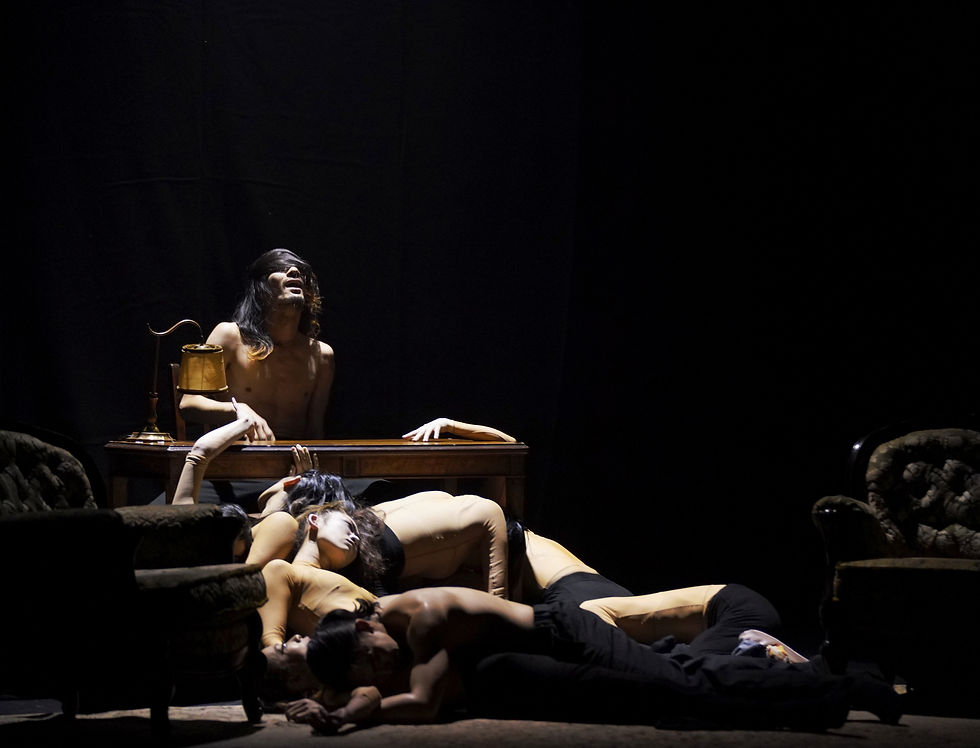
Satoshi Nakagawa, bare-chested, lies in the foreground of the stage. When Okamoto delivers Japanese monologues that reflect on the mirroring of the corporeal and ethereal domains, the dance begins to spiral into extremes of attraction, possession and violence.
Gendered Violence in Movement
The central tension of the work unfolds through duets and trios that reframe classical ballet with grotesque twists. Miwa Motojima, soaring in a purple dress with a defiant grand jeté, seems to leap not in joy but in escape from Nakagawa’s grasp, collapsing instead of resolving. Later, Yumika Yasuoka appears in a silky white costume; lifted, dragged, and manipulated between Nakagawa and Riku Ogawa, whose physical struggle suggests rivalry over her body. In ballet, what often reads as weightless lifting, for example, the Angel lift (where the male dancer lifts the female dancer to make her appear weightless like a flying angel), here feels like objectification, even brutality. Generally, gendered power dynamics in dance portray the man as the heroic figure and the woman as an object of desire. However, within the cultural norms shaped by Japanese society, ballet’s fantasies of femininity intersect with contemporary realities of misogyny. This portrayal of female victimization may unsettle some viewers, but it notably exposes the deeply ingrained patriarchy that persists in Japan.
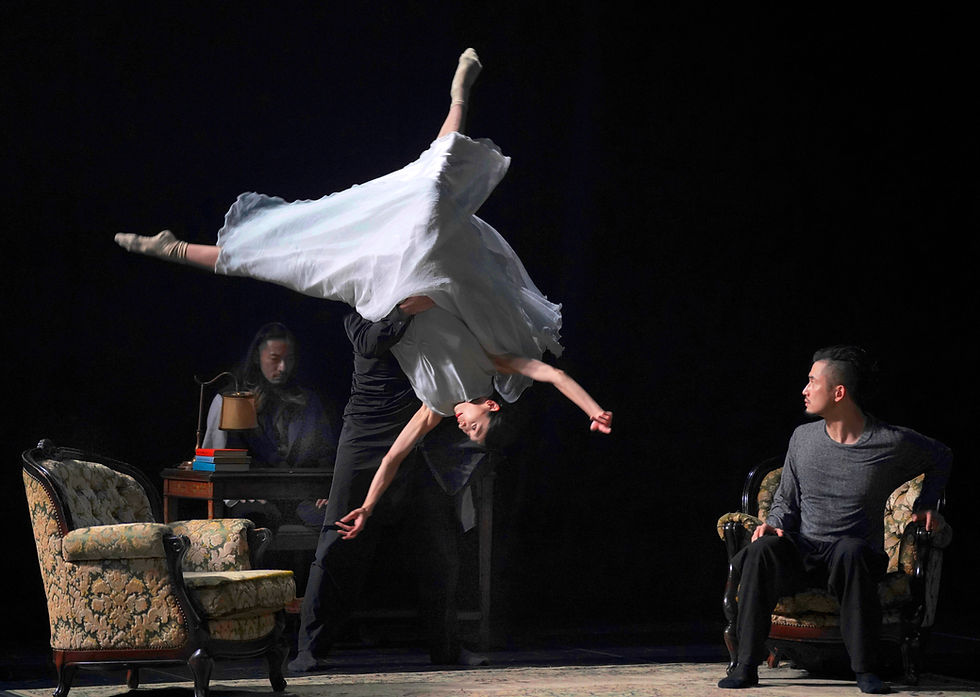
Okamoto’s recurring presence with the books becomes an almost judicial act of recording and reordering human deeds. At one point, under a wash of deep red light, the stage becomes a hellscape: chairs projected as shadows of cages on the curtains. Motojima and Yasuoka reappear at the stage corner in leotards, moving in mirrored and synchronized tranquillity like twins. On the contrary, the possessiveness in a man is intensified and transformed into competitiveness. Ogawa prowls after Mana Tazaki in a deadly haunting hide-and-seek. Defying fate by scattering books, Tazaki struggles in epilepsy-like movements against the floor before succumbing to Nakagawa’s violent hands, leaving him shattered by his own shocking act.
The Dreamscape as Abyss
Throughout, Nakagawa and Ogawa embody different facets of Kushida’s inner landscape — they are like doppelgangers chasing after and confronting each other, representing the yearning and the cruelty inscribed within the unconscious. If Pina Bausch reshaped dance theatre by exposing human vulnerability, Kushida highlights the unbearable darkness of desire, where attraction flips into domination. The choreography oscillates between the erotic, the grotesque, and the poignantly beautiful.

By the end, Nakagawa’s repeated returns to the first lying-down position evoke the Buddhist concept of reincarnation, underscored by the title Naraku — meaning both the mechanical underworld beneath the Kabuki/Japanese theatre stage, and the Buddhist hell-realm of endless suffering. Whether this cycle can ever be broken is left unanswered, but Kushida reveals the abyss as both personal and universal: a mirror in which honne (hidden true desires) clashes with tatemae (the socially acceptable self). Naraku is not an easy work; it exposes control, misogyny, and obsession with unflinching intensity. Yet it is precisely this brutality, embodied through wrenching choreography, that makes it unforgettable.


