

Alternative Roots Part I: A Refreshing Celebration of ESEA Identity and Being


A rare opportunity to explore and celebrate East and South-East Asian (ESEA) artists, Alternative Roots festival took place last month revealing a range of artists curated by Ming Strike. Organised by Kakilang, film, dance and fine arts collided at Hoxton Hall in an exploration of place, migrations, and the joy and challenges of ESEA identities in London. The first panel of the day, led by Ming Strike, Howl Yuan, and artists Jade Johnson and Bunga Yuridespita, set a precedent for the upcoming works and feel of the festival.
Ways of being, belonging, and shifting identities streamed through the conversation, however, what pervades most is a sense of wholeness, as opposed to something half or missing. Johnson herself encapsulated such notions with the line: “I am complete, and I embody layers of identities that belong together. I am made of layers, not fractions.” Throughout the day, across many performances, workshops and installations, the festival was an offering to embrace the fullness and multifaceted nature of East and South-East Asian identities, rather than individual and isolated occurrences rooted in a single place and time.
Despite the inherent seriousness of the underlying themes, the festival was punctuated with humour throughout. Burong Zeng and Funa Ye’s film UnboundZine self-mocks and chuckles at the artist’s dilemma of their work running away from them and taking on a personality of its own. Queerness is an accepted dimension, the characters – often representing multiple facades of the zine – are visually striking in bold make-up, translucent and colourful fabrics. We see a zine artist being interviewed or desperately searching for a way to make their zine successful: in a trip to the fortune teller’s, the zine’s destiny is pronounced as doomed, causing theatrical and hilarious distress. Beyond its obvious hilarity, the film is also infused with Burong and Ye’s intelligence and truthfulness expressed via the zine creator’s quest for publication, and perhaps for any writer striving to release their work into the world. As the zine is embodied through multiple personalities and states, its maker a satire of the serious and purposeful artist, the zine itself starts to take on a separate, unbound existence. Seeing the process in a literal form, acted out through people and in a recorded visual format, is biting and funny all at once.

As dryly mocking as it is of the artist, UnboundZine holds back no punches where the publishing process is concerned either. The film proclaims that the big milestone for a publication is to have its own ISBN – an obsession marked with an ISBN birthday cake and a giant barcode printed on the zine’s literal personification – and we see other glimpses of judgement (in a court, where better?) upon zines as a medium. Suddenly the publishing of an artistic work turns into the regulation of a product, the artist hungry for their work to be successful via a dictated system, even though zines are largely independent. Freedom and entrapment thus interplay on a subtle level, making UnboundZine contemplative and even concerning beneath the playfulness. Its collage nature, skipping back and forth between scenes, is delightful and feels like flipping through a zine in film form. Memorable and hilariously satirical, yet deeply Intelligent; UnboundZine shines a light on the relationships between artist, work and industry seldom spoken about.
In a complete turn from the literal and subtle, is Shuyi Gao’s In the Shadow, In the Light. A movement duet between two dancers, the work explores space and bodies moving through it in a way that verges upon, but doesn’t quite reach, phenomenological understanding. They warm their bodies up by swiftly rubbing down joints and muscle groups. Touch is extended into the rest of the as the dancers creep their hands along skirting boards, door frames, walls, all parts of the studio. What begins as a curious and informed exploration, however, loses focus as the work progresses. Heads are dunked in a bowl of water, a dancer crouches on a chair and allows it to balance precariously before it slams on the floor. There are many concepts here, perhaps too many, and what promises to flow well dissolves as the In the Shadow, In the Light overreaches and broadens beyond any followable path. Fragments of the dancers’ experimentation are genuinely interesting and hold potential: the sensation of space and body, particularly the communication of physical feeling, feels like a natural concept to build upon and what is delved into here is done with integrity. For now, however, the work calls for a more centred focus.
Turning to a work in progress, Night Archives presents curious interactions between its dancer and creator, Jan-Ming Lee, and her audience. Soft lighting, quietness and an informal space where viewers can sit where they like on the floor or on chairs, recreates the small hours of the morning. Lee lies on the floor, trying to sleep but unable to do so. She gets up, walking throughout the space, spelling out thoughts, with more scattered across the floor written out in tiny folded papers. Her midnight meanderings, now subject to our scrutiny, and also our participation, feel like a private cognitive space opening up and inviting us to share in her night time contemplation. We observe as Lee dances among us, perhaps twisting her hips, or sinking close to the floor before suddenly rising up in an unpredictable but gentle flow. Her movement is free, with no need or want for structure. The result is something individual to Lee, with the lightness of her personality coming through as she amuses herself by jumping and running through the space. It feels odd to witness something so supposedly private and typically unseen, but there is an implicit communal aspect that reduces any awkwardness as Lee remains aware of everyone in the room with her, and is keen for us to actively engage with her.
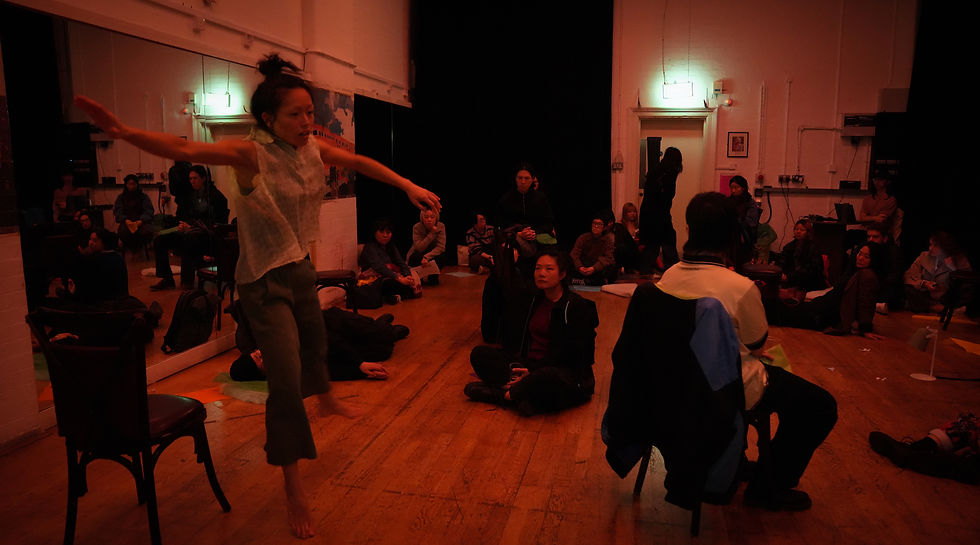
Coming away from movement as a solo focus, Lee redirects our attention to the scattered papers and language. She hands each of us one of these small paper fragments – mine reads “To fly and land on” – and allows us to reflect as she continues to move and narrate the thoughts that flit through her mind. With my fragment being specifically linked to movement, clearly an integral part of Lee’s being, the paper pieces seem to echo an aspect of her consciousness. In the busy midst of the festival, Lee offers a quiet interaction with her work that feels almost meditative, which promises to evolve into a considered probe into a hidden state of being.
Continuing a sense of gentile space, Bunga Yuridespita’s walking installation Past and Present draws attention to Hoxton Hall itself. Her torso encased in abstract cardboard cut-outs that have an industrial edge, Yuridespita refers to city architecture and people’s experiences of location. As she moves through the audience, who are scattered through the hall thanks to the relaxed seating of round tables and café-style chairs, high-pitched frequencies are picked up. These are broadcast aloud as Yuridespita’s vicinity to various objects changes, her relationship with the surrounding static setting amplified. Our attention as viewers is drawn not only to her, but to the venue itself, and our physical states as a temporary part of it. Past and Present is clearly an adaptable work that garners a variety of responses and discoveries in different settings: indeed, Yuridespita explained during the introductory panel talk that she has walked the piece through the streets of Brixton. Yet, I can’t help but feel its impact might be fuller in an outdoor urban setting – despite Past and Present being effective in a minimal indoor venue, its meaning feels restrained in the limited confines of Hoxton Hall. The cardboard shapes, layered like fragments of building facades all colliding across her body, have a natural pull towards the complexities of outdoor cityscapes. Like Yuridespita’s environment, Past and Present is constantly changing, whether it is the intensity of the noise or the reflection of the environment in the mirror placed at her chest; however, a more dynamic landscape rather than a still room would arguably complement the piece, and support Yuridespita’s delve into location.

Reflecting upon the festival, we live in a time when ESEA identities are becoming increasingly challenged and spaces celebrating diversity are needed more than ever – Alternative Roots not only celebrates but empowers its contributing artists through the festival’s accepting nature. As a result, the range of works shown at Alternative Roots opens a door to East and South-East Asian contemporary art in a warm yet contemplative and, at times, deeply expressive manner. Ever increasingly ubiquitous notions of division and hostility are rejected by the festival and its artists, simply through addressing personal perspectives or wider notions connected to ESEA identities such as belonging and ways of being - how refreshing to gather for connection and openness, and to embrace a multitude of voices.


