
Negotiating Wholeness and Uncertainty through Movement in ‘Deciphers’
- Elspeth Chan

- Dec 30, 2025
- 3 min read

Deciphers opens with a paper scroll stretched across the stage, layered with newspaper and magazine cutouts, its surface marked by Jean Abreu and Naishi Wang’s doodles. Two LED tubes rest on this collage, doubling as rulers and weights, underscoring the scroll’s symbolism on culture and language.
Abreu and Wang each take an edge of the scroll. Together, they slowly crumple and hug the paper to their chests, embodying the cultural tension bound up in immigrant identity. The sequence, accompanied by the sound of crinkling and a gradual sonic escalation of slow but deliberate drumbeats in techno-stomp pulses, evokes a push-pull of assertion and hesitation.
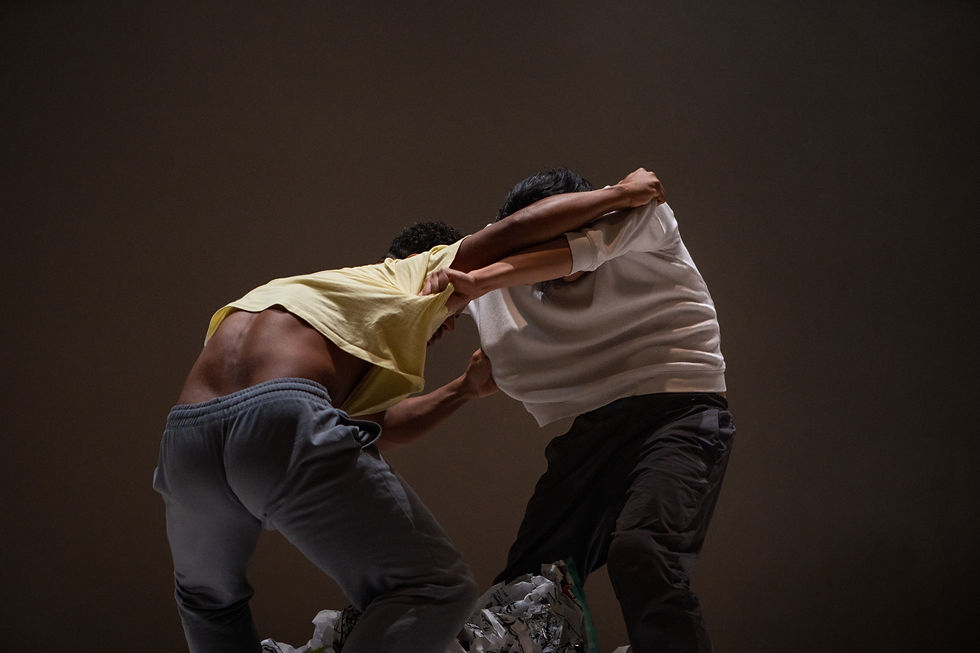
Once compressed beneath their knees, the scroll becomes a foundation for the performance: a hybrid space for cultural dialogue and exchange by the two dancers who experience consistent acts of translation not only in language but also in ways of being. Leaning into and away from each other, the dancers grip and tug at each other’s clothes, their bodies oscillating between closeness and distance. Abreu lifts Wang's legs up off the floor by gripping onto his trousers, transcending mere contact improvisation. The negotiation of fabric becomes a metaphor for skin, culture, and vulnerability. With eyes often closed, their connection relies on internal attunement over sight, demonstrating the significance of the body’s knowledge in translating the space.
Abreu’s eventual release leads to solo explorations in which the two dancers remain physically apart but kinesthetically responsive: torsos spun, hands waved, knees bent, and “dragon tail” acrodance ripples low across the stage. The open ‘space’ between them acts as an intangible third mover, expanding the dialogue beyond physical contact.
A shift to stark white light splits the set into bands of shadow and illumination. The mood becomes more introspective as Abreu and Wang layer spoken texts and movement, reflecting on their immigrant journeys. Wang’s exaggerated thumbs-up and rapid loose-wrist hand waves contrast with Abreu’s chest-driven pivots and guttural sounds, amplifying the emotional complexity of acculturation. When language becomes secondary, the body translates unspoken emotions.
Lines from Fernando Sabino’s Depois de Tudo and Mark Strand’s Keeping Things Whole are spoken aloud, weaving immigrant struggle to maintain wholeness amid uncertainty, expressed through layered vocalization in English and their mother tongues. As a trilingual person who understands English and Mandarin but not Portuguese, I find myself constantly shifting between understanding and deciphering, drawn into the roulette-like soundscape underscoring the repeated phrases “not enough”, “certainty” and “we have to continue.”

Projections split the shadows into three colored panels. Both the performers and the crushed scroll flicker through these segments, echoing fractured cultural inheritances and shifting self-perceptions. Silhouettes morph in scale as the dancers move, signifying the ongoing process of deciphering and reconstructing identity in a new land.
Abreu’s somatic movements, slightly hinting samba and capoeira, suggest a search for internal peace; Wang’s struggle is more visible: swinging and striking the sidewall. Later, Wang’s body, trembling while standing above the scroll, casts large, restless shadows in the centre, while Abreu lies down shaking gently by the side. Wang’s gesture of covering the crushed paper with his body becomes a powerful metaphor for the persistent battle with cultural misunderstanding. In the final sequence, they move together on all fours nodding heads, before diverging into a harmonious, sonically layered unison — an image of difference woven into solidarity.
Apart from movements reminiscent of Brazilian Jiu-Jitsu “shrimping” and chest lifts, the movement qualities are generally subdued rather than spectacular. Physicality is instead driven by nuanced, habitual gestures that punctuate the act of deciphering, moving from intimate bodily dialogues in shared space toward a deeper, ongoing and ambiguous exploration of identity. In this process, we come to sit with the differences in our parallel lives, whether through imitation, adaptation, or blending in, and by creating something new from this hybridity. Ultimately, Deciphers invites the audience to collectively contemplate upon the human inquiry of wholeness: an evolving negotiation between self and others.


